Setting & Sense of Place
Set in Jakar in the Choekhor Valley—the spiritual heartland of the country—Amankora Bumthang places guests beside a former royal residence, the Wangdicholing Palace, with monasteries and chortens scattered across farmland and forested slopes. The valley’s rhythm is unhurried: prayer flags flicker on ridgelines, orchards punctuate village lanes, and the air carries woodsmoke and birdsong. From here, many landmarks are reached on foot or by short drives, making the lodge an ideal base for days that blend gentle exploration with pockets of quiet reflection.
Design & Atmosphere
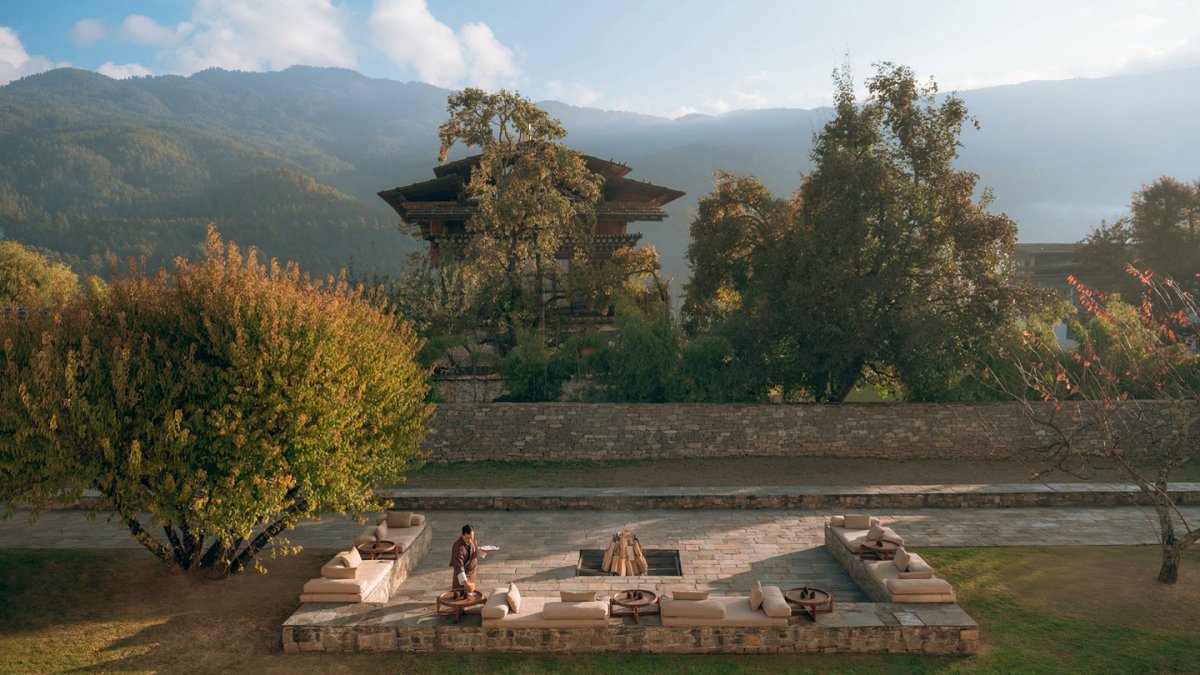
This property adopts a pared-back, dzong-inspired aesthetic—stone, timber, and whitewashed walls—allowing views and light to take center stage. A vaulted walkway leads toward common spaces and out to a terrace oriented for sunsets over the valley. After dark, a sunken hearth becomes the social heart, its glow matched by the clear, starry skies typical of high altitude. The mood is contemplative rather than ostentatious; interiors are warm, tactile, and purposefully uncluttered to echo the region’s monastic heritage.
Suites & Comfort
With just 16 suites, the lodge feels intimate. Rooms are generously sized and lined in honey-toned wood, with king beds, deep soaking tubs, and wood-burning stoves that take the edge off crisp evenings. Window seats frame valley or courtyard views—an effortless spot for tea, a book, or morning journaling. Storage is discreet, lighting is soft and layered, and amenities favor quality over excess. The overall effect is residential: more refined mountain retreat than conventional hotel room.
Dining & Ingredients
The culinary approach is seasonal and local, drawing on the valley’s buckwheat, barley, dairy, and orchard produce. Menus balance Bhutanese staples with restrained international plates, often highlighting vegetables roasted over open flame, broths infused with mountain herbs, and simple desserts that lean on fruit and local yoghurt. Lunches can be arranged outdoors—on a grassy slope above the river or on the terrace facing temple roofs—while dinners are unrushed, sometimes concluding around the courtyard fire with a nightcap beneath clear skies.
Experiences & Surrounds
Days here are shaped by short, meaningful outings. The Kurjey Lhakhang complex—three temples associated with Guru Rinpoche—sits in a grove of cypress and 108 small stupas, offering a layered introduction to the valley’s spiritual lineage. Nearby Zangdopelri, a more recent consecration, provides an elegant counterpoint. Farther afield, the so-called Burning Lake (Mebar Tsho) is reached via a scenic drive into Tang Valley; the gorge’s rushing water and clusters of butter lamps give the site a solemn, memorable atmosphere. Closer to town, gentle trails thread between farmsteads and fields, with pauses for butter-tea, buckwheat pancakes, or simply the stillness that defines this region.
Wellness & Pace
After time on the trail or temple steps, the spa focuses on unhurried bodywork rooted in regional botanicals. Treatments favor grounding oils, herbal compresses, and restorative rituals designed for altitude; the aim is to steady the mind as much as to loosen travel-tired muscles. Mornings often begin quietly—with a stroll through pine-scented air, or a few minutes of breathwork by open windows—setting a tone that tends to linger long after departure.
Service Style & Practicalities
Amankora Bumthang functions both as a standalone stay and as a chapter in the wider Amankora journey across five valleys. Stays commonly include guiding and transfers, which simplifies the logistics of mountain roads and leaves more time for discovery. The lodge’s compact scale, walkable setting, and proximity to major sites mean there is little friction in the day: breakfasts expand into late mornings, lunches become small picnics, and golden hour has a way of drawing everyone back to the terrace.
Verdict
For travelers seeking immersion rather than spectacle, this accommodation succeeds by staying true to place. Its architecture recedes to frame the valley; its cuisine reflects nearby fields and dairies; its experiences are intimate rather than exhaustive. Across a few unhurried days, guests tend to collect not just photographs of temples, but a quieter memory: how it feels when pace, landscape, and ritual fall gently into step.